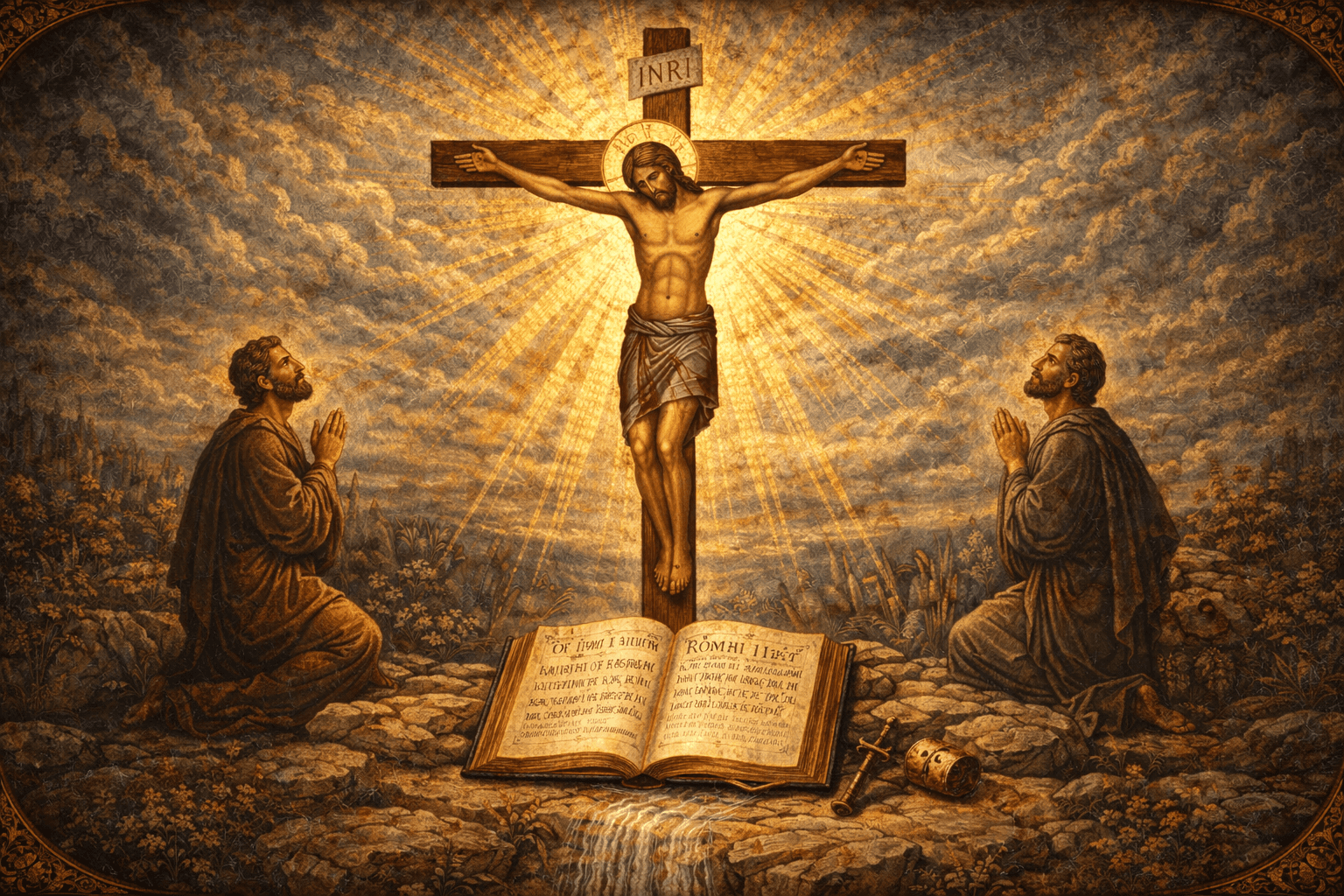
Book of Romans — Summary and Key Themes
The Book of Romans is a letter written by the Apostle Paul to the church in Rome around 57 AD. It is considered the most systematic theological exposition of the Christian Gospel in the New Testament, covering sin, justification by faith, sanctification, the role of Israel, and Christian living. Key passages include Romans 1:16-17, 3:23, 6:23, 8:1, 8:28, and 12:1-2.
If you want to understand what Christianity is actually about — not the cultural version, not the watered-down version — read Romans. It's 16 chapters, written by Paul to a church he'd never visited, and it lays out the Gospel with more precision and depth than anything else in the New Testament.
Martin Luther read it and sparked the Reformation. Augustine was converted through it. John Wesley felt his heart "strangely warmed" while hearing it read aloud. Romans has a track record.
Here's what it says and why it still matters.
Background: Who Wrote It and Why
Paul wrote Romans around 57 AD from Corinth, near the end of his third missionary journey. He was writing to a church he hadn't founded and hadn't visited — which is partly why Romans is so systematic. He can't assume they know his teaching, so he lays it all out.
His immediate purpose: to introduce himself before his planned visit to Rome, and to ask for their support in a future mission to Spain. His theological purpose: to present a comprehensive account of the Gospel and its implications for both Jewish and Gentile believers in the church — a community that had real tensions between the two groups.
The Structure — Romans in Six Movements
Chapters 1-3: The problem. Everyone — Jew and Gentile — is under sin and under God's just judgement. Romans 3:23 (NKJV): "For all have sinned and fall short of the glory of God."
Chapters 3-5: The solution — justification. God declares sinners righteous through faith in Jesus Christ. Not earned, not deserved. Received. Romans 5:1 (NKJV): "Therefore, having been justified by faith, we have peace with God through our Lord Jesus Christ."
Chapters 6-8: The new life — sanctification. Because we are justified, we're no longer enslaved to sin. Romans 8:1: "There is therefore now no condemnation to those who are in Christ Jesus." Chapter 8 is the summit of the letter.
Chapters 9-11: The question of Israel. What about God's promises to Israel? Paul addresses this with nuance — God's purposes haven't failed; they're being worked out through a remnant and ultimately through the full inclusion of the Gentiles.
Chapters 12-15: The practical implications. Romans 12:1-2 is the hinge: present your bodies as living sacrifices. Then Paul works through what renewed minds look like in community — love, service, handling conscience questions, relating to governing authorities.
Chapter 16: Personal greetings. Often skimmed, but historically fascinating — Paul names 26 people, many of them women in prominent roles.
The Verses You Need to Know
Romans is the source of more foundational Christian statements than almost any other book. Here are the key ones:
Romans 1:16 (NKJV) — "For I am not ashamed of the gospel of Christ, for it is the power of God to salvation for everyone who believes." The thesis statement of the letter.
Romans 3:23 (NKJV) — "For all have sinned and fall short of the glory of God." The universal diagnosis.
Romans 6:23 (NKJV) — "For the wages of sin is death, but the gift of God is eternal life in Christ Jesus our Lord." The problem and the solution in one sentence.
Romans 8:1 (NKJV) — "There is therefore now no condemnation to those who are in Christ Jesus." The ground of Christian assurance.
Romans 8:28 (NKJV) — "And we know that all things work together for good to those who love God, to those who are the called according to His purpose." One of the most quoted and most misunderstood verses in the Bible.
Romans 8:38-39 (NKJV) — "For I am persuaded that neither death nor life, nor angels nor principalities nor powers... shall be able to separate us from the love of God which is in Christ Jesus our Lord."
Romans 10:9-10 (NKJV) — "If you confess with your mouth the Lord Jesus and believe in your heart that God has raised Him from the dead, you will be saved." The most direct statement of how salvation is received.
Romans 12:1-2 (NKJV) — "Present your bodies a living sacrifice... be transformed by the renewing of your mind." The pivot from theology to practice.
What Romans Means for You Today
Romans was written to a church dealing with internal division — Jewish and Gentile Christians couldn't agree on food laws, calendar observance, and who exactly was in and out of God's family. Paul's answer to all of it: you're all justified by faith, you're all under the same grace, so treat each other accordingly.
That's still the answer to most church division today.
More personally: Romans 8 is the chapter to return to when life is hard. Not because it promises everything will be easy, but because it makes the case — systematically, with argument not just feeling — that nothing in all creation can separate you from God's love. Not your worst failure. Not your hardest season. Not death itself.
That's not sentiment. That's a theological argument Paul builds from chapters 1 through 7, arriving at chapter 8 as a conclusion that the whole letter supports.
Start Here If You Want to Understand Christianity
If someone asked me where to start reading the Bible to understand what Christianity is actually about, I'd say Romans. Not because it's easy — it's not — but because it's honest. It doesn't pretend human beings are basically fine. It doesn't offer cheap comfort. It builds a case, piece by piece, for why the Gospel is the most important news in human history.
Read it slowly. Use a good translation — the NKJV gives you accuracy with readable English. And if you want to go deeper on any of the themes, explore our other articles on salvation and the Gospel.
Key Bible Verses
Romans 1:16-17, Romans 3:23, Romans 3:24, Romans 5:1, Romans 5:8, Romans 6:23, Romans 8:1, Romans 8:28, Romans 8:38-39, Romans 10:9-10, Romans 12:1-2

Author
Shafraz Jeal
Shafraz Jeal is a Christian writer, evangelist, and ministry leader with a passion for seeing lives transformed by the gospel. Formerly a Muslim, Shafraz encountered Jesus Christ in 2016, a turning point that reshaped every part of his life. Since then, he has served in church leadership, led evangelism initiatives, and ministered in deliverance and healing. Shafraz combines biblical depth with a heart for practical discipleship, equipping believers to live boldly for Christ and inviting seekers to discover the truth of the gospel.
FAQS
What is the main theme of the Book of Romans?
The main theme is justification by faith — the teaching that sinful human beings are declared righteous before God not through their own merit or religious effort, but through faith in Jesus Christ. Paul states this thesis in Romans 1:16-17 and builds the argument systematically across the letter.