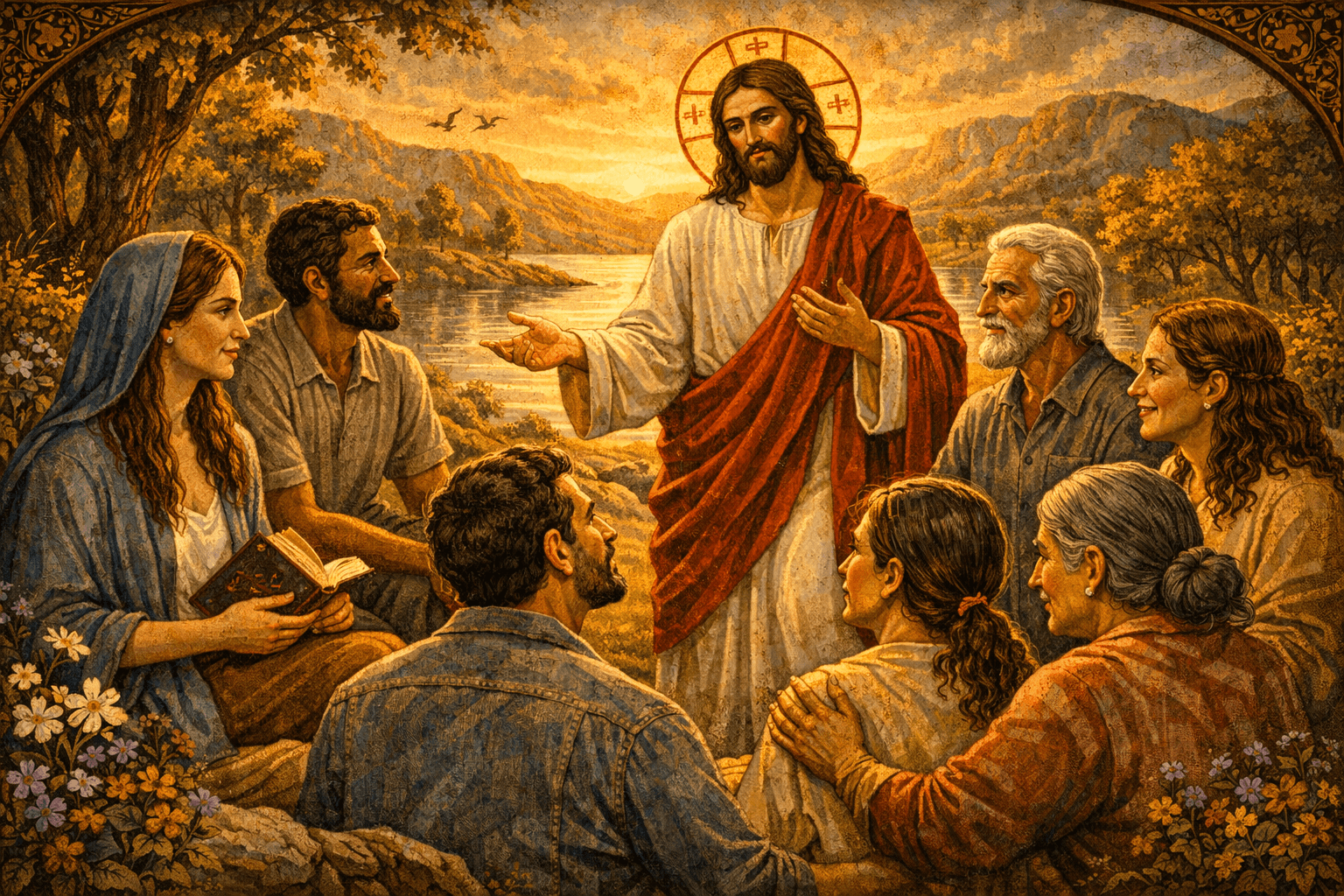
How to Share Your Faith Naturally
Sharing your faith (evangelism) is a biblical calling for all Christians, described in Matthew 28:18-20, Acts 1:8, and 1 Peter 3:15. The New Testament model is primarily relational and conversational — people sharing the Gospel in the context of real relationships and real life, rather than through formal programmes or confrontational methods.
I've had hundreds of conversations about faith. In gyms, on building sites, in barber shops, over a pint. And almost none of them started with me announcing: "I'd like to share the Gospel with you today."
Most of them started with something real. A question. A problem someone was working through. A moment where normal conversation hit something deep.
The fear most Christians have about sharing their faith is that they'll have to become a different, slightly awkward version of themselves — clipboard in hand, scripted presentation, prepared for rejection. That version of evangelism does exist. It's just not the primary model in the New Testament.
What the Bible Actually Says About Sharing Your Faith
1 Peter 3:15 (NKJV) is the verse most often quoted on this topic: "But sanctify the Lord God in your hearts, and always be ready to give a defense to everyone who asks you a reason for the hope that is in you, with meekness and fear."
Notice what triggers the conversation: someone asks you. They see something in you — a quality of life, a peace under pressure, a response to difficulty that doesn't match what they'd expect — and they ask why.
This is not a passive approach. It requires you to actually live in a way that raises questions. If nothing about your life is different from everyone else's, nobody is going to ask about the hope that's in you.
Colossians 4:5-6 (NKJV) adds: "Walk in wisdom toward those who are outside, redeeming the time. Let your speech always be with grace, seasoned with salt, that you may know how you ought to answer each one." Salt adds flavour — it makes conversation worth having. Grace means you're not trying to win an argument; you're caring about a person.
The New Testament Model Is Mostly Conversational
Look at how Jesus operated. In John 4, He asked a Samaritan woman for a drink of water. That was His opening. From there, the conversation moved naturally through her life, her questions, and eventually to who He was.
Paul in Athens (Acts 17) didn't open by condemning the city's idols. He started with what he observed: "I see that you are very religious." He engaged with their culture, quoted their own poets, and used their existing questions as the entry point.
Philip and the Ethiopian eunuch (Acts 8) began with a question: "Do you understand what you are reading?" The Ethiopian had questions. Philip started there.
The pattern in the New Testament is not proclamation without relationship. It's proximity, genuine interest, and responding to what's already there.
Practical — What This Looks Like in Real Conversations
Here's what I've found works, from years of actually doing this in ordinary places:
Be genuinely interested in people. The best evangelism conversations I've had started with me actually caring about what someone was going through. Not as a tactic — genuinely. People can tell the difference between someone who sees them as a conversion project and someone who actually wants to know them.
Share your story, not a formula. You don't need to memorise a presentation. You have a story — what your life was like before faith, what changed, what God has done. That's yours. Nobody can argue with your experience.
Ask good questions. Questions are more powerful than statements in early conversations. "What do you make of all that?" "Have you ever thought about that?" "What do you believe happens when we die?" Open questions that invite, not interrogate.
Don't feel you have to close every conversation. You're planting or watering — not necessarily harvesting. 1 Corinthians 3:6 says Paul planted, Apollos watered, but God gives the growth. Your job is faithfulness in the conversation you're actually in, not managing the outcome.
Pray for the people around you by name. Before any conversation happens. Consistently. The spiritual dimension of evangelism is real — and prayer is the part that happens before the conversation.
What About the Hard Part — The Moment It Gets Awkward?
It will get awkward sometimes. Someone will push back. Someone will mock you. Someone will dismiss you.
Romans 1:16 (NKJV): "For I am not ashamed of the gospel of Christ, for it is the power of God to salvation for everyone who believes." Paul wrote that having been beaten, imprisoned, and shipwrecked for the Gospel. His confidence wasn't in his persuasive technique. It was in the message itself.
You don't have to defend God. God is quite capable of that. Your job is to represent the Gospel honestly and trust that it has power in it — that when people genuinely encounter the real thing, not a performance of Christianity, something can happen that you couldn't manufacture anyway.
2 Corinthians 5:20 (NKJV): "Now then, we are ambassadors for Christ, as though God were pleading through us: we implore you on Christ's behalf, be reconciled to God." An ambassador represents someone else. You're not the source of anything — you're carrying a message. That takes the weight off.
The Ordinary Obedience of It
The Great Commission in Matthew 28 is not a call for a professional class of evangelists. It's for everyone. But it doesn't require everyone to become a street preacher or a door-knocker.
It requires you to live authentically as a follower of Jesus — in your workplace, your gym, your family, your neighbourhood — in a way that raises questions. And then to be ready, with gentleness and respect, to answer them.
The most powerful evangelism I've ever seen hasn't been at large meetings or events. It's been a Christian who, in the middle of something genuinely hard, responded with a peace and a groundedness that made the person next to them think: I want what they've got.
That's 1 Peter 3:15 working exactly as it's supposed to.
If you want to go deeper on the Gospel itself — so you know what you're sharing — read our article on what the Gospel actually is. And if you have someone in your life you're praying for, you can send us a prayer request and we'll pray with you.
Key Bible Verses
1 Peter 3:15, Matthew 28:18-20, Acts 1:8, Colossians 4:5-6, Romans 1:16, 2 Corinthians 5:20, Acts 17:22-34, John 4:7-26, 1 Corinthians 9:22-23

Author
Shafraz Jeal
Shafraz Jeal is a Christian writer, evangelist, and ministry leader with a passion for seeing lives transformed by the gospel. Formerly a Muslim, Shafraz encountered Jesus Christ in 2016, a turning point that reshaped every part of his life. Since then, he has served in church leadership, led evangelism initiatives, and ministered in deliverance and healing. Shafraz combines biblical depth with a heart for practical discipleship, equipping believers to live boldly for Christ and inviting seekers to discover the truth of the gospel.
FAQS
Is every Christian supposed to share their faith?
Yes — the Great Commission in Matthew 28:18-20 is given to all disciples, not just a professional class of evangelists. However, 'evangelism' looks different for different people. Some will have gift-level evangelism. Others will share faith through long-term relationships, service, or the quality of their life. All Christians are called to be ready to give an account of their hope (1 Peter 3:15).