What Does Heaven Look Like?
The Bible's most detailed description of heaven appears in Revelation 21-22, which describes a renewed creation — a city called the New Jerusalem — with specific dimensions, materials, and features. It includes twelve gates made of pearl, streets of pure gold, a river of life, and the tree of life. The defining characteristic of heaven in Scripture is not its architecture but the presence of God: "the Lord God Almighty and the Lamb are its temple" (Revelation 21:22, NKJV).

Author
Shafraz Jeal
Read Time
7
min
Updated
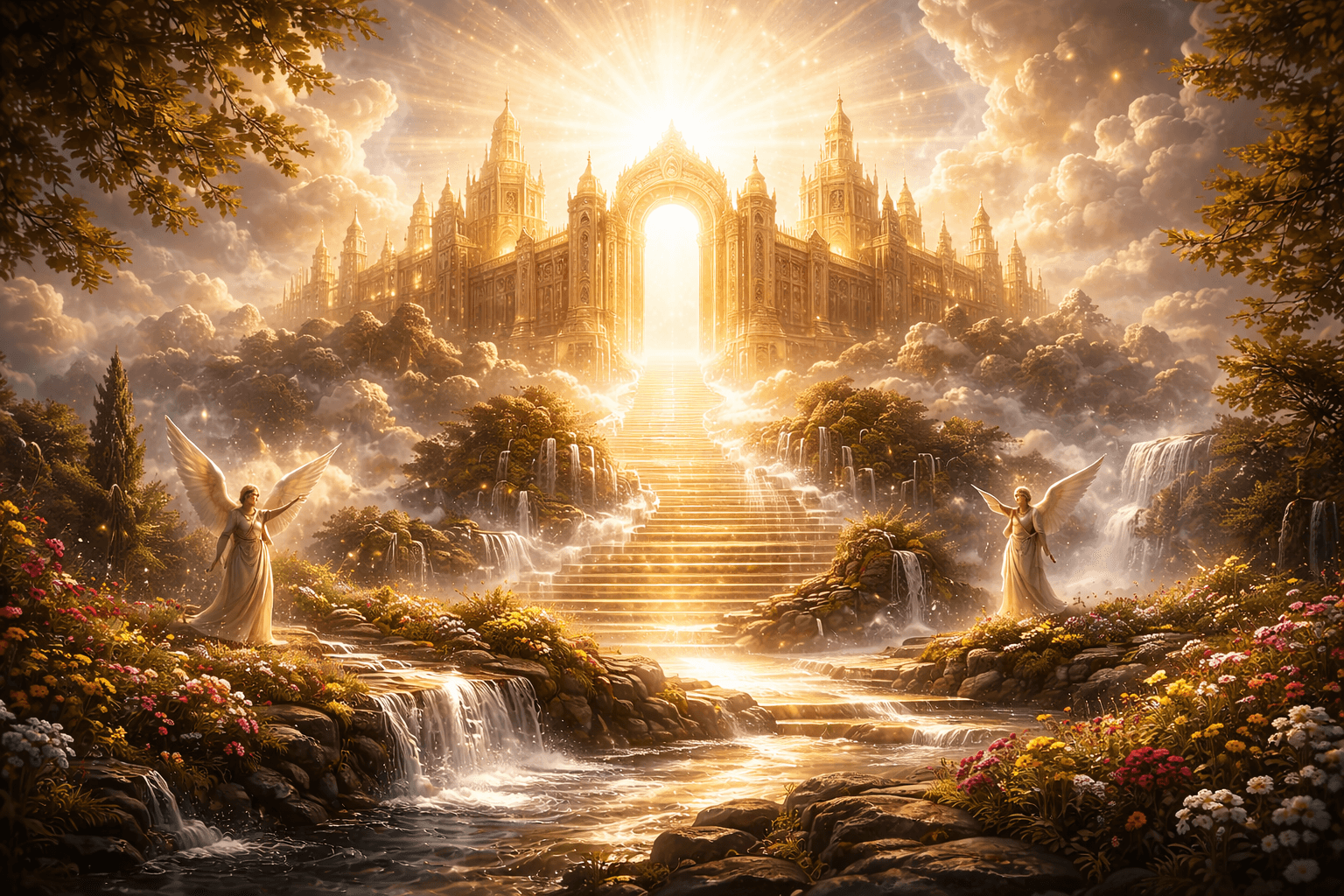
The image most people carry of heaven — clouds, white robes, harps, a vague sense of floating — comes almost entirely from cartoons and greeting cards. It has almost nothing to do with what the Bible actually says.
The Bible's description of heaven is far more physical, far more specific, and far stranger than that. Revelation 21 gives us dimensions. Materials. A river. A city with gates made of single pearls. If you've never read it carefully, it reads less like a spiritual concept and more like an architect's brief for something that has never been built yet.
Heaven Is a City, Not a Cloud
The most detailed picture of heaven in the Bible comes in Revelation 21-22 — and the first thing to notice is that it's described as a city. The New Jerusalem, coming down from God out of heaven, prepared like a bride.
John gives specific measurements: 12,000 furlongs in each direction — roughly 1,400 miles long, wide, and tall. The wall is 144 cubits. The foundations are decorated with twelve different precious stones — jasper, sapphire, chalcedony, emerald. The twelve gates are each made of a single pearl. The main street is pure gold, but gold described as transparent — like glass.
"And I saw no temple in it, for the Lord God Almighty and the Lamb are its temple. The city had no need of the sun or of the moon to shine in it, for the glory of God illuminated it. The Lamb is its light." (Revelation 21:22-23, NKJV)
No sun. No moon. The light source is God Himself. And no temple — because the temple was always the place where God's presence dwelt, and in the new creation, that presence is everywhere. There is no designated place to go to meet with God. You're already there.
The River and the Tree
Revelation 22 opens with a river — the river of the water of life, clear as crystal, flowing from the throne of God and of the Lamb down the middle of the city's street. On either side of the river: the tree of life, bearing twelve kinds of fruit, a different fruit every month, with leaves for the healing of the nations.
This is significant. The tree of life was in the Garden of Eden at the beginning of the story (Genesis 2:9). Humanity lost access to it when sin entered (Genesis 3:22-24). At the end of the story, in the new creation, there it is again — restored, thriving, bearing continuous fruit. The Bible's narrative begins in a garden and ends in a city with a garden at its centre. It's not starting over. It's returning to what was always meant to be.
What Heaven Won't Have
Some of the most striking things about Revelation's description of heaven are what's absent. Revelation 21:4 (NKJV):
"And God will wipe away every tear from their eyes; there shall be no more death, nor sorrow, nor crying. There shall be no more pain, for the former things have passed away."
No death. No grief. No pain. Not managed or reduced — gone. The things that make life heavy here are described as "former things" that have passed away entirely. This is not a slight improvement on the current situation. It is a complete break from it.
No night either (Revelation 22:5). No hunger. No thirst. No tears. The list of absences is itself a portrait of what this existence costs us — and what will no longer cost anything.
What Jesus Said About It
Before Revelation was written, Jesus gave His disciples a simpler promise:
"In My Father's house are many mansions; if it were not so, I would have told you. I go to prepare a place for you. And if I go and prepare a place for you, I will come again and receive you to Myself; that where I am, there you may be also." (John 14:2-3, NKJV)
The emphasis in Jesus' words isn't on the architecture. It's on the last line: where I am, there you may be also. The point of heaven, according to Jesus, is proximity to Him. The descriptions in Revelation elaborate on what that looks like. But the core of it is relationship, not real estate.
1 Corinthians 2:9 (NKJV) adds the honest acknowledgement that our current imagination simply isn't up to the task: "Eye has not seen, nor ear heard, nor have entered into the heart of man the things which God has prepared for those who love Him." The descriptions we have are real. They are also, in the end, a fraction of what is actually waiting.
More Physical Than You Thought
One of the things that surprises people when they actually read Revelation 21-22 is how physical it is. Gold. Pearls. A river. Fruit. Nations walking in the light of it. This is not a disembodied existence floating in spiritual mist. The Bible's vision of heaven is of a restored, renewed, physical creation — one in which everything that was broken has been made right and everything that was good has been made permanent.
If you've spent most of your life imagining heaven as an endless church service in the clouds, read Revelation 21 slowly. It will rearrange your expectations considerably — and probably for the better.
FAQS
What does heaven look like in the Bible?
Is heaven a real physical place?
What will we do in heaven?
Will we recognise each other in heaven?
Is heaven the same as the new earth?
Author
Shafraz Jeal
Shafraz Jeal is the founder of By Design Ministry, created to help people discover Jesus, understand the Bible, and grow in faith. After encountering Christ in 2016, his life was radically changed, and that journey continues to shape everything he shares.
You may also like these
Related Post