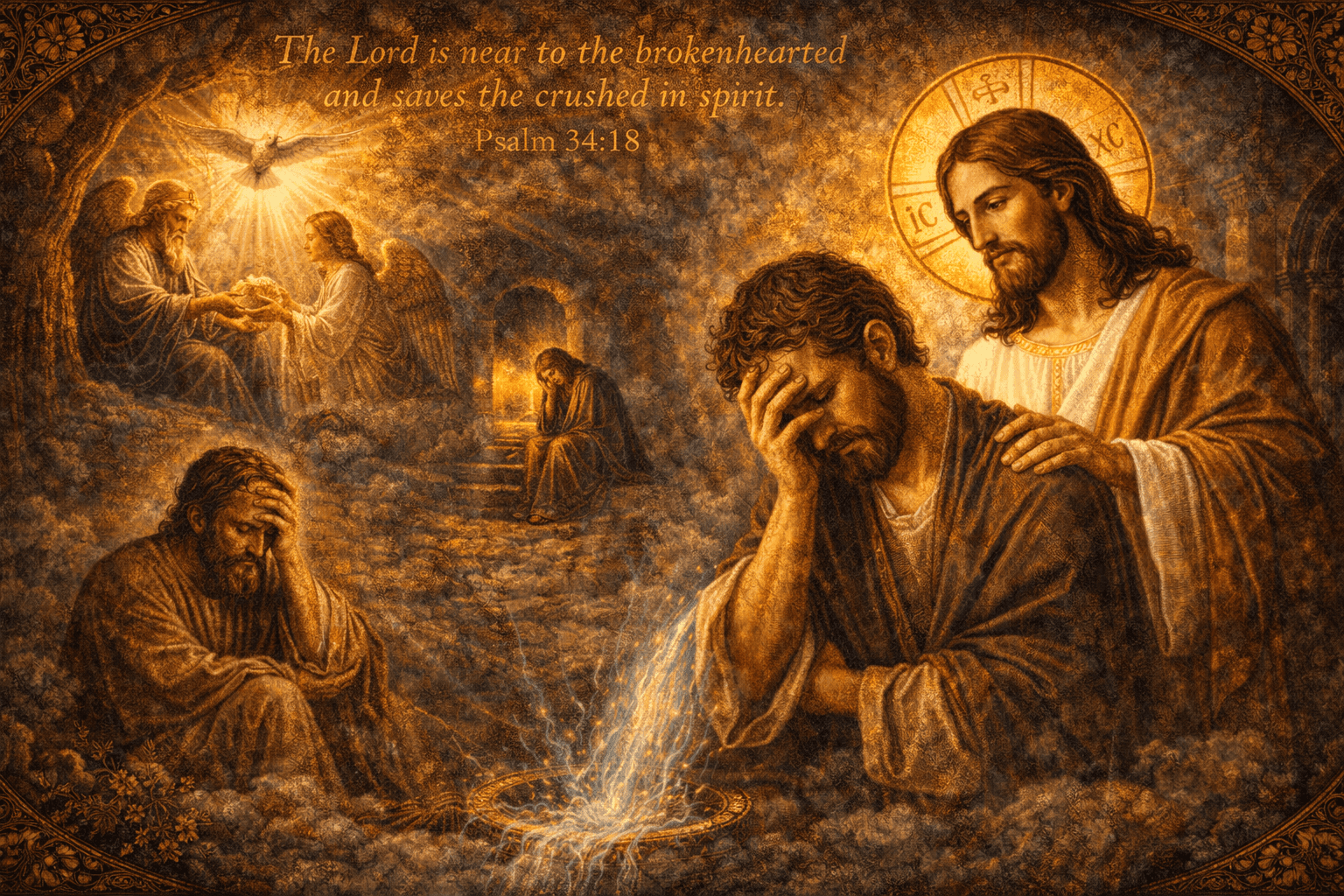
What Does the Bible Say About Mental Health?
The Bible addresses mental and emotional suffering extensively — through the Psalms, the experiences of figures like Elijah, David, and Jeremiah, and direct teaching from Jesus. While the Bible does not use modern clinical terminology, it speaks honestly about depression, anxiety, grief, suicidal ideation, and emotional breakdown, while pointing to God's presence as a source of stability and hope.
There's still a version of Christianity that quietly suggests if you're struggling mentally, you must be doing something wrong spiritually. Not enough faith. Not enough prayer. Not trusting God properly.
That version is not in the Bible.
The Bible is full of people in mental and emotional crisis — prophets who wanted to die, kings who couldn't get out of bed, a God-man who wept in public. What Scripture offers isn't a quick fix or a formula. It offers something more honest: presence in the darkness, not removal of it.
The Bible Doesn't Spiritually Bypass Suffering
Elijah — one of the greatest prophets in the Old Testament — had a breakdown. After a major victory at Mount Carmel, he ran into the wilderness, sat under a tree, and asked God to let him die. "It is enough! Now, Lord, take my life" (1 Kings 19:4, NKJV). That's suicidal ideation in the Bible, spoken by one of the most significant figures in the whole of Scripture.
God's response is not a rebuke. It's food, water, rest, and the words: "Arise and eat, for the journey is too great for you." (1 Kings 19:7). God addressed the physical before the spiritual. He met Elijah in his exhaustion, not past it.
David wrote Psalm 22 from a place of complete desolation: "My God, My God, why have You forsaken Me?" Psalm 42:5-6 records him talking to his own soul: "Why are you cast down, O my soul? And why are you disquieted within me? Hope in God." He's not performing faith — he's fighting for it while being honest about the darkness.
Jesus and Emotional Suffering
John 11:35 — the shortest verse in the Bible — is also one of the most significant: "Jesus wept."
At the tomb of Lazarus, knowing He was about to raise him from the dead, Jesus still wept. He entered into the grief rather than bypassing it with His power. That's not weakness. That's the character of a God who takes human suffering seriously.
In Gethsemane, before the crucifixion, Matthew 26:38 says Jesus told His disciples: "My soul is exceedingly sorrowful, even to death." Luke records that His sweat was like drops of blood — a recognised physiological response to extreme psychological distress. The Son of God experienced something that looks remarkably like what we'd now call an acute stress response.
What Scripture Offers — and What It Doesn't Promise
Matthew 11:28-30 (NKJV): "Come to Me, all you who labour and are heavy laden, and I will give you rest. Take My yoke upon you and learn from Me, for I am gentle and lowly in heart, and you will find rest for your souls."
This is an invitation to bring your exhaustion to Jesus — not to perform wellness in front of Him. The promise is rest, not instant resolution. A shared yoke means He's in it with you.
Psalm 34:18 (NKJV): "The Lord is near to those who have a broken heart, and saves such as have a contrite spirit." Near — not fixing from a distance. Presence is the promise, not instant transformation.
Isaiah 40:29-31 speaks of God giving strength to the weary and increasing power to the weak. But even in this passage, it acknowledges that "the youths shall faint and be weary, and the young men shall utterly fall" — the reality of exhaustion is named before the renewal is promised.
What the Bible does not offer: a guarantee that faith in God means you will never struggle mentally. The Psalms would not exist if that were the case. What it offers is companionship, a God who understands human suffering from the inside, and the hope of ultimate restoration.
Faith and Seeking Help — Not Either/Or
One of the most damaging ideas still circulating in some Christian communities is that seeking professional help for mental health is a sign of weak faith. This isn't biblical.
Luke, who wrote both the Gospel of Luke and the book of Acts, was a physician (Colossians 4:14). Paul referred to him as "the beloved physician" — and nothing in the New Testament suggests that using a doctor was spiritually inferior to prayer alone. In fact, Paul told Timothy to drink wine for his stomach (1 Timothy 5:23) — a physical remedy for a physical problem, from the man who wrote most of the New Testament.
Seeking a therapist, counsellor, or doctor for mental health is not faithlessness. It is wisdom. The brain is an organ. Treating its disorders with appropriate care is no different from treating any other part of the body.
Prayer and therapy are not in competition. Many Christians find that both together — Scripture, community, professional support — are how God brings healing in practice.
You Are Not Less Faithful for Struggling
If you are struggling with your mental health right now, this is not a sign that your faith is failing. Elijah struggled. David struggled. Jeremiah struggled. Jesus Himself entered into the deepest human suffering willingly.
What God offers in that place is not a shame-free escape, but a shame-free presence. He is near to the broken-hearted. He gives strength to the weary. He wept at a tomb.
If you're carrying something heavy right now, you don't have to carry it alone. You can submit a prayer request here and we'll pray with you. And if you need professional support, please do seek it — that is wisdom, not weakness.
If you are in crisis right now, please contact the Samaritans on 116 123 (UK, free, 24/7).
Key Bible Verses
Psalm 34:18, Psalm 42:5-6, 1 Kings 19:1-8, Psalm 22:1, Matthew 11:28-30, John 11:35, Romans 8:26, 2 Corinthians 1:3-4, Philippians 4:13, Isaiah 40:29-31

Author
Shafraz Jeal
Shafraz Jeal is a Christian writer, evangelist, and ministry leader with a passion for seeing lives transformed by the gospel. Formerly a Muslim, Shafraz encountered Jesus Christ in 2016, a turning point that reshaped every part of his life. Since then, he has served in church leadership, led evangelism initiatives, and ministered in deliverance and healing. Shafraz combines biblical depth with a heart for practical discipleship, equipping believers to live boldly for Christ and inviting seekers to discover the truth of the gospel.
FAQS
Is depression a sin?
No. Depression is a medical condition with both physiological and psychological components. The Bible never frames depression as a spiritual failing — David, Elijah, Jeremiah, and even Jesus display what we would recognise as depressive symptoms. The Bible responds to these experiences with compassion, not condemnation.