Hallelujah Meaning: What the Word Actually Says
Hallelujah is a Hebrew word meaning "praise Yahweh" or "praise the Lord." It is formed from two Hebrew words: hallel, meaning to praise or boast, and Jah, which is a shortened form of Yahweh — the personal name of God revealed in the Old Testament. Hallelujah appears 24 times in the Old Testament, predominantly in the Psalms, and four times in the New Testament in Revelation 19 — making it one of the very few Hebrew words preserved untranslated across the entire Bible.

Author
Shafraz Jeal
Read Time
6
min
Updated
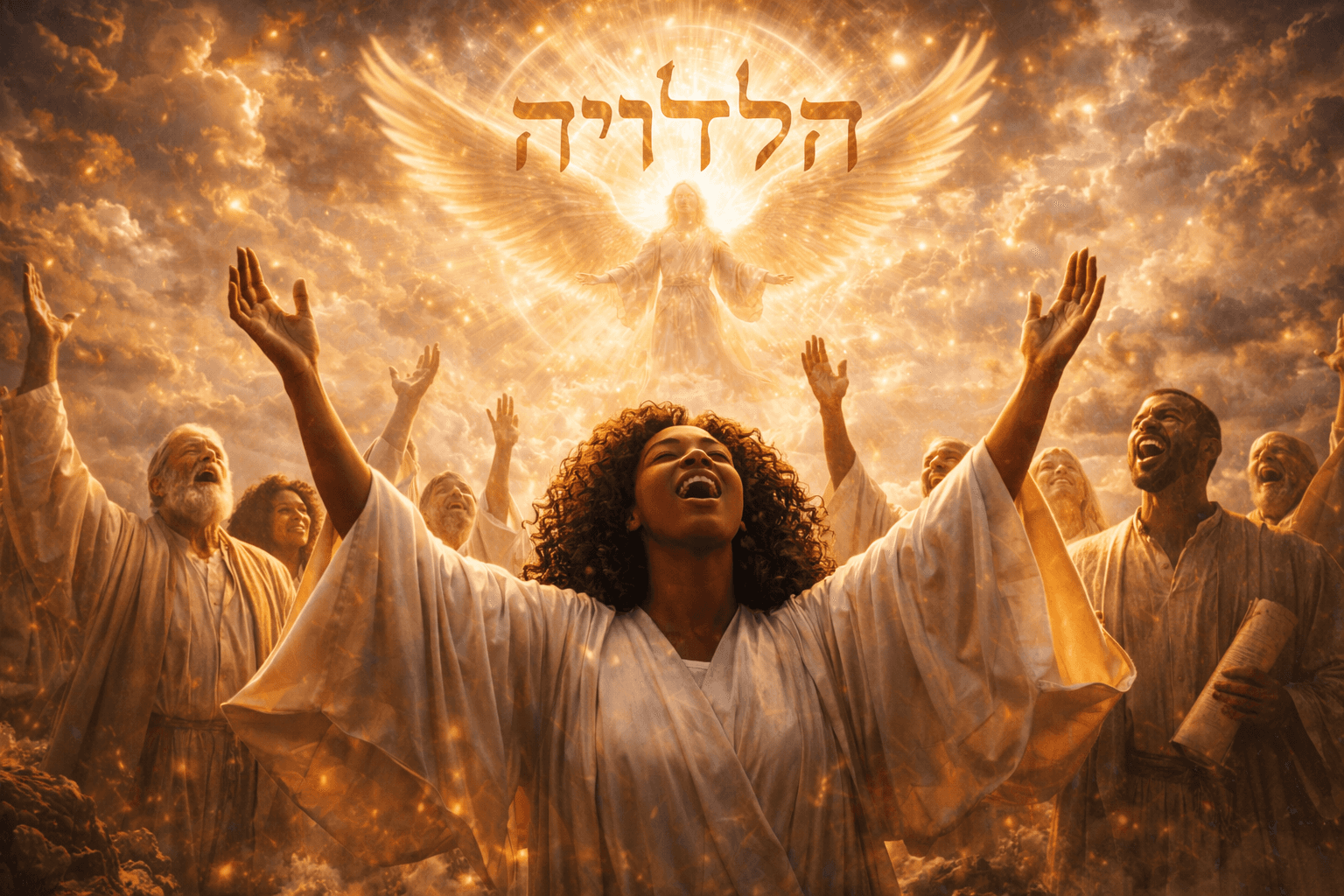
It's in Handel's Messiah. It's in Leonard Cohen's most famous song. It's shouted in gospel churches and whispered in cathedrals. It crosses language barriers, genre boundaries, and centuries without needing translation — because it was never translated in the first place.
Most people who say hallelujah have no idea that when they say it, they are using God's actual personal name. Not a title. Not a description. His name.
What the Word Is Made Of
Hallelujah is a compound Hebrew word: hallel + Jah.
Hallel comes from the Hebrew verb meaning to praise, to boast, to shine — it carries the sense of exuberant, loud, public celebration. It's the same root behind the "Hallel" — a collection of Psalms (113-118) sung at Jewish festivals including Passover. When Jesus and the disciples sang a hymn at the Last Supper before going to the Mount of Olives (Matthew 26:30), they were almost certainly singing these Psalms.
Jah is the contracted form of Yahweh — the name God gave Moses at the burning bush when Moses asked who was sending him: "I AM WHO I AM" (Exodus 3:14, NKJV). Yahweh is the most personal, most sacred name for God in the Hebrew scriptures. Jah is its shortened form — and it's embedded in hallelujah every time you say it.
So hallelujah does not mean "praise the Lord" in a generic sense. It means "praise Yahweh" — specifically, the God of Abraham, Isaac, and Jacob, the God who brought Israel out of Egypt, the God whose name is I AM. The word is specific in a way most people never realise.
Where It Appears in the Psalms
The word appears most densely at the end of the Psalter — the final five psalms (146-150) each begin and end with hallelujah. Psalm 150 is essentially one long crescendo of it:
"Praise Him with the sound of the trumpet; praise Him with the lute and harp! Praise Him with the timbrel and dance; praise Him with stringed instruments and flutes! Praise Him with loud cymbals; praise Him with clashing cymbals! Let everything that has breath praise the Lord. Praise the Lord!" (Psalm 150:3-6, NKJV)
The Psalter — the whole book, with all its grief and confusion and honesty — ends here. With every instrument. With everything that breathes. With hallelujah. It's the direction the whole collection is moving toward, even through the darkest psalms. Even Psalm 88, which ends without resolution, exists in a book whose final word is praise.
Four Times in Revelation — and Why That Matters
Hallelujah appears in the New Testament only in Revelation 19 — and it appears four times in rapid succession. This is significant because Revelation 19 is set after the fall of Babylon, the great system of human pride and corruption that has opposed God throughout history. As it collapses, heaven responds:
"And I heard, as it were, the voice of a great multitude, as the sound of many waters and as the sound of mighty thunderings, saying, 'Alleluia! For the Lord God Omnipotent reigns!'" (Revelation 19:6, NKJV)
The word that opened Psalms of individual praise is now being shouted by a multitude that sounds like crashing water and rolling thunder. The hallelujah of one person in a quiet moment and the hallelujah of every redeemed voice across history are the same word — spoken to the same God, about the same reign.
Handel understood this when he set Revelation 19 to music in the Hallelujah Chorus — the tradition of standing during it reflects the sense that something weighty is happening in the room when it's performed. Whether or not you stand, the text behind it is genuinely overwhelming if you know what it's describing.
Why It Was Never Translated
Hallelujah crossed from Hebrew into Greek, from Greek into Latin, from Latin into English, and from English into hundreds of languages — without ever being translated. Every other Hebrew word got rendered into the local language. This one didn't.
The most likely reason is that it was already so established in worship — sung in synagogues, in early Christian gatherings, across communities that spoke different languages — that changing it would have felt like breaking something. The word had a life of its own in the mouths of worshippers. It still does.
Which means that when a gospel choir in Lagos and a cathedral choir in London and a small congregation in Seoul all sing hallelujah, they are saying exactly the same word in exactly the same way it was said three thousand years ago in the Jerusalem temple. The linguistic thread has never been cut.
More Specific Than You Thought
Hallelujah is not a vague exclamation of religious enthusiasm. It is a precise statement addressed to a specific God whose name it contains. Every time you say it — in church, in a song, under your breath — you are saying: praise Yahweh. Praise the God who was and is and is to come. Praise the one whose name is I AM.
That's not small. The word has survived three thousand years without needing a single change because what it says doesn't need improving. Some things don't.
FAQS
What does hallelujah mean?
Where does hallelujah come from?
Is hallelujah the same as alleluia?
What does Jah mean in hallelujah?
Why do people say hallelujah in church?
Author
Shafraz Jeal
Shafraz Jeal is the founder of By Design Ministry, created to help people discover Jesus, understand the Bible, and grow in faith. After encountering Christ in 2016, his life was radically changed, and that journey continues to shape everything he shares.
You may also like these
Related Post