How Tall Was Goliath?
The height of Goliath depends on which ancient manuscript you read. The Masoretic Text — the basis for most English Old Testament translations — gives his height as six cubits and a span, calculated at approximately nine feet nine inches (2.97 metres). The Dead Sea Scrolls and the earliest Greek Septuagint give a height of four cubits and a span — approximately six feet nine inches (2.06 metres). Both versions present Goliath as an extraordinary warrior, but the difference in numbers significantly affects how his confrontation with David is understood.

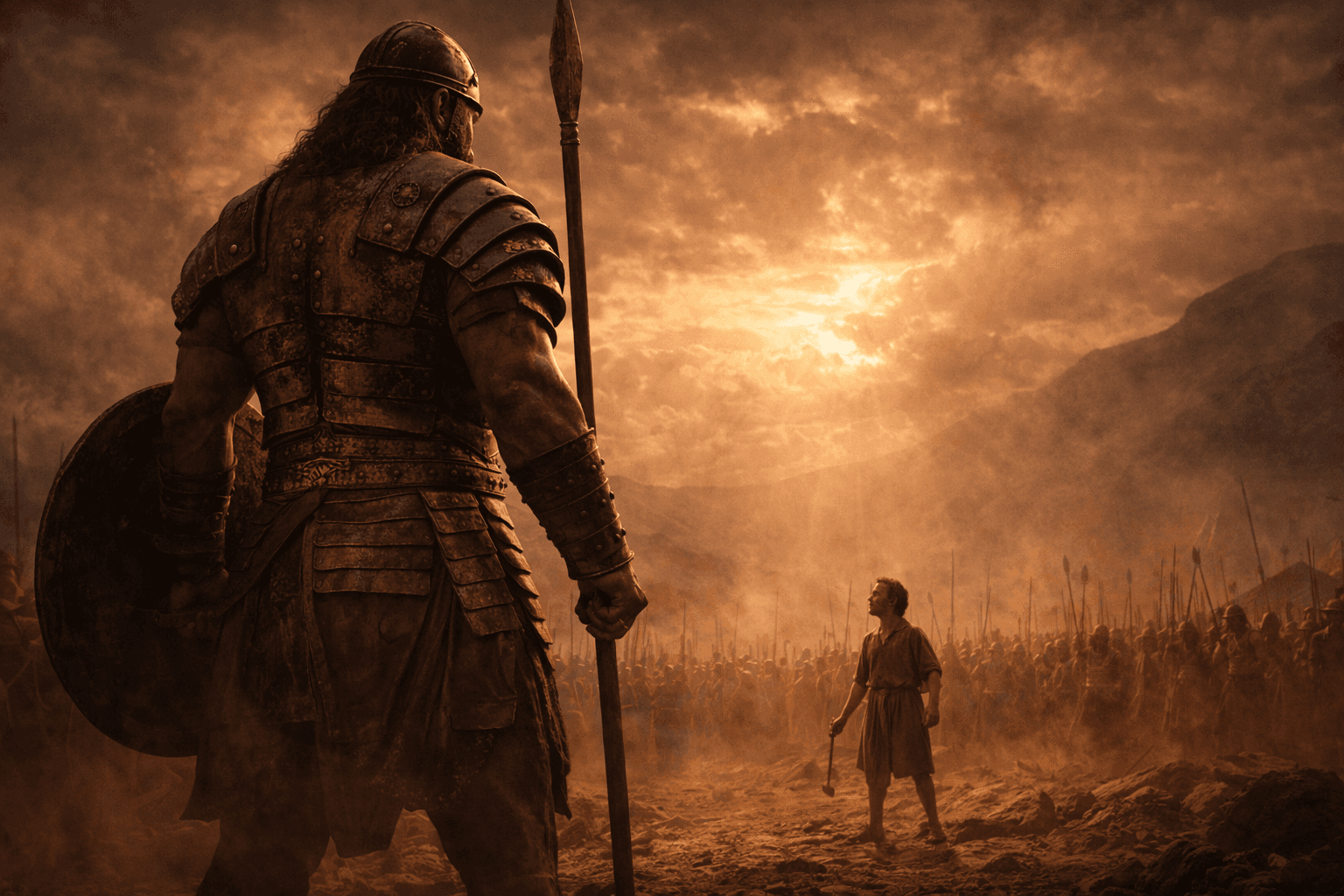
Everyone knows Goliath was big. The question of exactly how big turns out to be more complicated than most people expect — and the complication is not a problem for the Bible, it's actually an invitation into how ancient texts were preserved and transmitted.
But beyond the numbers, there's something more important in the David and Goliath story that gets missed when we focus only on the size gap. The real question the story is asking is not "how big was he?" It's "what does it mean to walk into a fight like that, and why?"
The Two Different Numbers
1 Samuel 17:4 in the Masoretic Text — the Hebrew manuscript tradition that underlies most modern English Bibles — gives Goliath's height as "six cubits and a span." A cubit is typically calculated at 18 inches, a span at 9 inches, giving a total of approximately 9 feet 9 inches. That's an extraordinary height by any standard — well beyond anything recorded in modern athletic history.
However, the Dead Sea Scrolls — the oldest surviving Hebrew manuscripts, discovered in 1947 and predating the Masoretic Text by roughly 1,000 years — give Goliath's height as "four cubits and a span." So does the Septuagint, the early Greek translation of the Hebrew scriptures. Four cubits and a span comes out at approximately six feet nine inches — still formidable for the ancient world, still taller and larger than almost everyone around him, but in the range of a very large human rather than something almost supernatural.
Scholars are divided on which reading is original. Some argue that scribal error inflated the six to four during transmission. Others argue the shorter figure was the original and was later expanded to heighten the drama. What both agree on is that Goliath was a professionally trained, heavily armed, experienced warrior — and that whatever his exact height, the odds were not in David's favour.
What We Know for Certain About Goliath
Whatever his height, the description of his armament in 1 Samuel 17 is specific and consistent across manuscripts. His bronze helmet. His coat of armour weighing five thousand shekels of bronze — roughly 125 pounds. Bronze shin guards. A bronze javelin between his shoulders. A spear with an iron tip weighing six hundred shekels — about fifteen pounds. And a shield-bearer walking ahead of him.
He was not just tall. He was a weapons system. The description reads like a military inventory, because that's what it is. This is what a fully equipped Philistine champion looked like, and the Israelite army — watching him come out every morning for forty days to make his challenge — had collectively decided that no one was willing to go out to meet him.
The Philistines had iron technology that Israel largely lacked (1 Samuel 13:19-22). Goliath represented the military, technological, and physical superiority of Israel's enemy. His challenge was not just personal — it was a statement about which god was more powerful.
The Boy Who Came Out to Meet Him
David was not a soldier. He was there to deliver food to his brothers. He heard the challenge. He asked what would be done for the man who killed this Philistine. His older brother accused him of arrogance. And then he said something that reveals exactly how he was thinking about the situation:
"For who is this uncircumcised Philistine, that he should defy the armies of the living God?" (1 Samuel 17:26, NKJV)
Everyone else was looking at Goliath and calculating their chances. David was looking at Goliath and asking a theological question: by what right does this man challenge the God of Israel? His framing was different from the beginning. Where the army saw an unbeatable warrior, David saw a man who had made the mistake of positioning himself against God.
When he speaks to Saul, he recounts killing a lion and a bear while protecting his father's sheep. Not as boasting — as evidence. Each time, God had delivered the animal into his hand. He had a track record. Not with armies. With specific moments of impossible odds where God had shown up.
"The Lord, who delivered me from the paw of the lion and from the paw of the bear, He will deliver me from the hand of this Philistine." (1 Samuel 17:37, NKJV)
He went out with a sling and five stones. He refused Saul's armour because he hadn't tested it — he used what he knew. And his words to Goliath before the fight are worth reading slowly:
"You come to me with a sword, with a spear, and with a javelin. But I come to you in the name of the Lord of hosts, the God of the armies of Israel, whom you have defied." (1 Samuel 17:45, NKJV)
One stone. Slung into the forehead. Goliath fell.
Why the Height Matters Less Than the Question
Whether Goliath was nine feet nine or six feet nine, the structure of the story is the same: a superior human force was defeated by someone who had no business winning by human calculation, because the fight was defined differently by the person who won it.
David didn't go out to prove he was brave. He went out because he believed the terms of the fight were wrong — this was not a contest between two men. It was a challenge against the God of Israel, and that changed the odds entirely. The height of Goliath is the point where most people start reading. David's question — who is this man to defy the living God? — is where the story actually begins.
The Giant Is Not the Main Character
Goliath's height has fascinated people for centuries, and the manuscript question is genuinely interesting for anyone who cares about how the Bible was transmitted. But the story of David and Goliath is not ultimately about the size of the enemy. It's about the frame through which you look at the enemy.
David's frame was: God is bigger than this. Not as a slogan — as a conclusion drawn from specific, personal experience of God showing up when the odds were wrong. That's not recklessness. That's a particular kind of faith, built on a particular kind of history. The giant's exact height, in the end, was irrelevant. What mattered was what David believed about the God he was fighting for.
FAQS
How tall was Goliath in the Bible?
Was Goliath a real person?
How did David kill Goliath?
Why was no one willing to fight Goliath before David?
What does the story of David and Goliath mean in the Bible?
Author
Shafraz Jeal
Shafraz Jeal is the founder of By Design Ministry, created to help people discover Jesus, understand the Bible, and grow in faith. After encountering Christ in 2016, his life was radically changed, and that journey continues to shape everything he shares.
You may also like these
Related Post