Is God Real? Here's an Honest Answer
The question of whether God is real is one of the most significant questions a person can ask. The evidence considered includes cosmological arguments (why does anything exist at all), the fine-tuning of the universe for life, the near-universal human experience of moral obligation, the historical evidence for the resurrection of Jesus Christ, and the testimony of personal encounter and changed lives. No single argument is conclusive on its own. Together, they form a cumulative case that honest enquiry takes seriously.


I didn't grow up a Christian. I came to faith as an adult, after a life that had taken some hard turns, after asking this exact question seriously and not being satisfied with easy answers on either side.
So when someone asks me whether God is real, I don't want to give them a pamphlet. I want to give them an honest conversation — the kind I needed when I was asking it myself. That means taking the question seriously, not pretending the evidence is overwhelming and obvious, and not pretending it's absent either.
Here's what I actually think, and why.
The Question Deserves More Than a Quick Answer
Most people asking "is God real" are not looking for a philosophical treatise. They're asking because something happened. A loss. A moment of beauty that felt like it pointed somewhere. A conversation. A quiet hour at 2am when the usual distractions weren't working. The question comes from somewhere personal, even when it sounds academic.
That means the honest answer has to engage both the head and the experience behind the asking. And it has to be prepared to say: I don't have proof in the sense of a laboratory experiment. What I have is a cumulative case — evidence from several directions that, taken together, points toward something.
Why There Is Something Rather Than Nothing
The cosmological question is the oldest one: why does anything exist at all? Every physical thing we can observe had a cause. Trace the chain of causes back far enough and you arrive at a beginning — which science itself now largely accepts. The universe had a start.
But here's the problem: if everything that exists had a prior cause, what caused the first thing? A cause outside the universe — outside space, time, and matter — is the most coherent explanation for why a universe exists at all. Atheism's alternative — that the universe came from nothing, uncaused, for no reason — is not simpler. It's actually the stranger claim.
Romans 1:20 (NKJV): "For since the creation of the world His invisible attributes are clearly seen, being understood by the things that are made, even His eternal power and Godhead, so that they are without excuse." Paul's point is that creation itself is evidence — not proof in a courtroom sense, but the kind of evidence that makes the question of God unavoidable for any honest person.
Psalm 19:1 (NKJV): "The heavens declare the glory of God; and the firmament shows His handiwork." The universe is not a neutral data set. It has the quality of something made.
The Problem of Moral Knowledge
Here's something worth sitting with: every human culture that has ever existed has had a concept of moral obligation — some things are right, some things are wrong, and those distinctions are not merely preferences. You feel it when someone is genuinely cruel to a child. You don't think "that's not my preference." You think "that is wrong."
Where does that come from? Evolution can explain why we developed cooperative instincts. It cannot explain why we believe some things are objectively wrong — not just evolutionarily disadvantageous, but actually, morally, wrong. That sense of moral reality points toward a moral lawgiver. You can't have a law without a legislator. You can't have objective moral facts without something that grounds them beyond human preference.
C.S. Lewis made this argument famously, but it didn't start with him. It's a recognition that most people have never thought through but feel the weight of when it's put plainly.
The Historical Question About Jesus
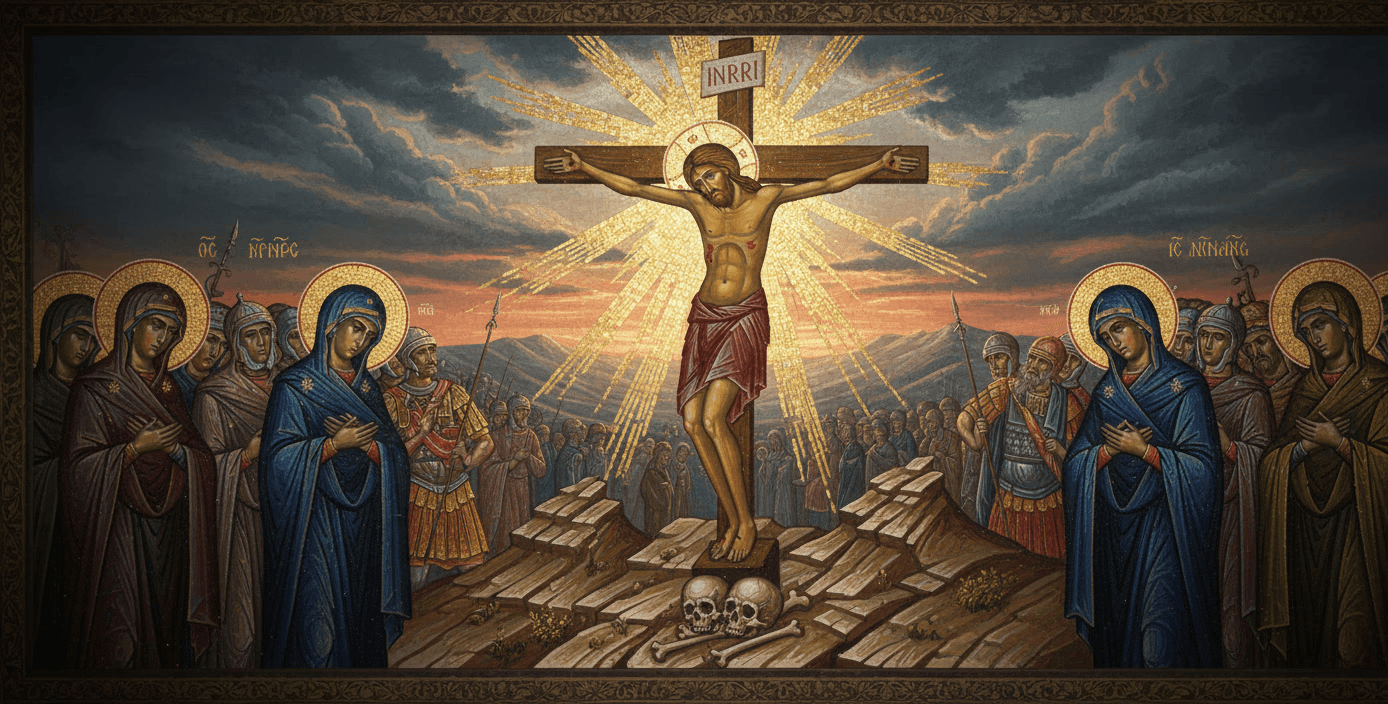
Christianity is not primarily a philosophy. It's a claim about something that happened. Specifically: that a man named Jesus of Nazareth was crucified under Pontius Pilate, died, was buried, and three days later was physically raised from the dead — and that this was witnessed by multiple people across multiple occasions.
1 Corinthians 15:3-8 (NKJV) is one of the earliest documents in the New Testament, written roughly 20 years after the crucifixion, and it lists witnesses by name: Peter, then the twelve, then over five hundred people at once, then James, then Paul himself. This is not mythology. It has the quality of legal testimony — names, numbers, people who could be questioned.
The historical question is simply: how do you explain the empty tomb and the radically transformed disciples? The men who had fled and hidden when Jesus was arrested were, fifty days later, publicly declaring His resurrection in the same city where He had been killed — willing to die for that claim. Something happened. The most historically coherent explanation for all the evidence is that what they said happened actually happened.
The Evidence Nobody Talks About
The evidence that gets the least airtime in these conversations is the one I find most compelling: changed lives. Not in a vague, spiritual way. In a specific, documented, repeatedly observed way across two thousand years and every culture on earth.
People who had every reason to keep living as they were — addictions, violence, bitterness, self-destruction — who encountered Jesus and became different people. Not improved. Different. The change has a specific character that doesn't match therapy or self-help: it comes from outside, it is often instantaneous in part, and it produces a particular kind of love, peace, and endurance that is consistently recognisable across cultures and centuries.
Romans 8:16 (NKJV): "The Spirit Himself bears witness with our spirit that we are children of God." There is a category of evidence that is experiential rather than logical — the direct experience of God's presence, which many people across history have described in strikingly similar terms. That evidence can't be handed to you. But it's available. Jesus Himself says in John 7:17 (NKJV): "If anyone wills to do His will, he shall know concerning the doctrine, whether it is from God." The experiment requires a willing participant.
What to Do With the Question
I'm not going to tell you the evidence is so overwhelming that only a fool could miss it. Honest people have looked at the same evidence and come to different conclusions. Doubt is a real thing. The hiddenness of God — the fact that He doesn't simply appear and make the question easy — is something the Bible itself acknowledges (Isaiah 45:15).
What I will tell you is this: the question deserves better than a dismissal in either direction. If you've been assuming God isn't real without seriously examining the case for Him, that's not scepticism — it's a different kind of faith. Honest scepticism looks at the evidence from both directions.
And if you're open to it, the most direct route is not another argument — it's a direct request. Ask God, if He's there, to make Himself known to you. Jesus says in Matthew 7:7-8 (NKJV): "Ask, and it will be given to you; seek, and you will find; knock, and it will be opened to you." That's not a guarantee of a particular experience. It's an invitation into an experiment that has been taken up by millions of people across history — and the results are worth paying attention to.
FAQS
Is there evidence that God exists?
How do you know God is real?
What does the Bible say about knowing God exists?
What if I have doubts about God being real?
If God is real, why doesn't He make it more obvious?
Author
Shafraz Jeal
Shafraz Jeal is the founder of By Design Ministry, created to help people discover Jesus, understand the Bible, and grow in faith. After encountering Christ in 2016, his life was radically changed, and that journey continues to shape everything he shares.
You may also like these
Related Post