Melchizedek: The Most Mysterious Figure in the Bible
Melchizedek is a figure in the Bible who appears briefly in Genesis 14:18-20, is referenced in Psalm 110:4, and is extensively discussed in Hebrews 5-7. He was king of Salem and a priest of God Most High who blessed Abraham and received tithes from him. The book of Hebrews uses Melchizedek as a theological type for Jesus Christ — particularly his lack of recorded genealogy, birth, or death, and his combined role as both king and priest, which prefigures Christ's eternal priesthood.

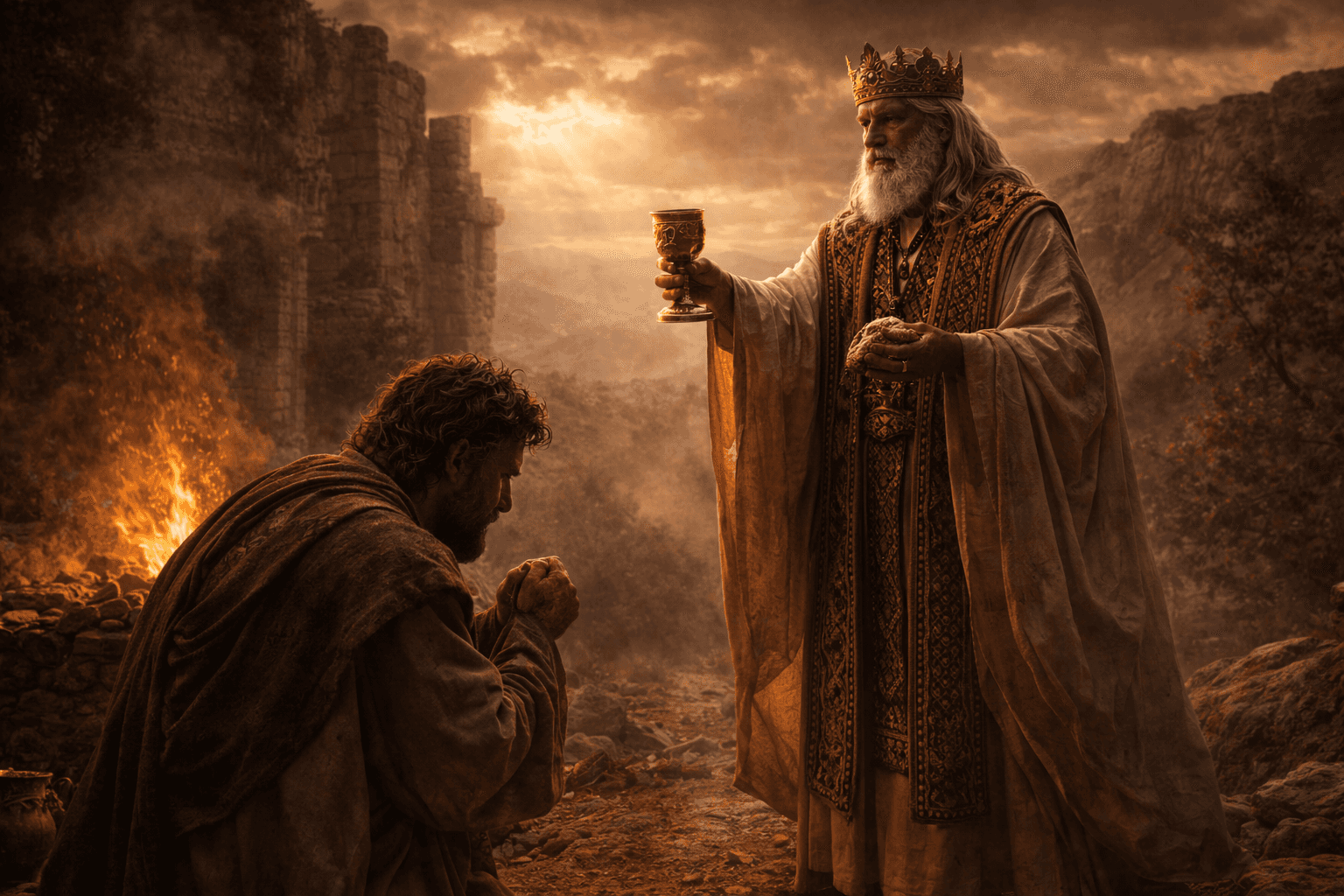
He walks into the Bible with no introduction and walks out the same way. Two verses in Genesis. A single line in a Psalm. And then, a thousand years after the Psalm, the writer of Hebrews spends three chapters unpacking what those two verses mean — because they mean more than almost any other two verses in the Old Testament.
Melchizedek is one of those figures who rewards the patient reader. On the surface, he appears and disappears so quickly that you could miss him entirely. But the New Testament treats his brief appearance in Genesis as one of the most significant foreshadowings of Jesus Christ in all of Scripture. Understanding why changes how you read both the Old Testament and the book of Hebrews.
Who Melchizedek Was — and What Makes Him Strange
Genesis 14 records Abraham returning victorious from a battle in which he rescued his nephew Lot. As he returns, he encounters Melchizedek:
"Then Melchizedek king of Salem brought out bread and wine; he was the priest of God Most High. And he blessed him and said: 'Blessed be Abram of God Most High, possessor of heaven and earth; and blessed be God Most High, who has delivered your enemies into your hand.' And he gave him a tithe of all." (Genesis 14:18-20, NKJV)
Three verses. King of Salem — most scholars identify Salem as an early name for Jerusalem. Priest of God Most High — the Hebrew is El Elyon, the same God Abraham worshipped. He brings bread and wine. He blesses Abraham. Abraham gives him a tenth of the battle spoils. And then he disappears from the narrative completely.
What makes him immediately strange is what the text doesn't include. Every significant figure in Genesis comes with a genealogy — this is how the ancient world established identity and legitimacy. Melchizedek has none. No father. No mother. No record of birth. No record of death. He simply is — already in existence, already functioning as a priest-king — when Abraham arrives. The writer of Hebrews will later make very specific use of this silence.
His name also carries meaning: melech means king, tzedeq means righteousness. King of righteousness. And Salem means peace. He is, as Hebrews points out, king of righteousness and king of peace — in that order. Righteousness comes before peace. That sequencing is not accidental.
The Line in Psalm 110
Melchizedek vanishes from Genesis and doesn't appear again until Psalm 110 — a messianic psalm attributed to David, written approximately 1,000 years after Genesis 14. In the middle of a psalm about a coming king who will reign at God's right hand, there is a single declarative verse:
"The Lord has sworn and will not relent, 'You are a priest forever according to the order of Melchizedek.'" (Psalm 110:4, NKJV)
God is making an oath about a future priest-king who will belong to Melchizedek's order — not the Levitical priesthood that governed Israel's religious life, but a different, older, more permanent order. Jesus quotes Psalm 110 in the Gospels (Matthew 22:44). The early church identified Him as its fulfilment.
What Hebrews Does With This
The writer of Hebrews is working with an audience of Jewish believers who understood the Levitical priesthood deeply — and who might have wondered: if Jesus is our high priest, why doesn't He come from the priestly tribe of Levi? He was from the tribe of Judah. By the Mosaic law, He had no right to be a priest at all.
The answer comes through Melchizedek. Hebrews 7:3 (NKJV) describes him as "without father, without mother, without genealogy, having neither beginning of days nor end of life, but made like the Son of God" — and then draws the conclusion: he remains a priest continually. The absence of a recorded genealogy is read as a deliberate theological statement: Melchizedek's priesthood was not derived from human lineage. It was of a different order.
And if Abraham — from whom Levi descended — paid tithes to Melchizedek, then Melchizedek's priesthood is greater than the Levitical one. In paying tithes to Melchizedek, Abraham was, in a sense, acknowledging a higher order that superseded what would come later through his own descendants.
Hebrews 7:24-25 (NKJV) then makes the direct application: "But He, because He continues forever, has an unchangeable priesthood. Therefore He is also able to save to the uttermost those who come to God through Him, since He always lives to make intercession for them." Jesus is the priest after Melchizedek's order — not appointed by genealogy, not limited by mortality, serving forever, interceding always.
Why a Two-Verse Character Matters This Much
Melchizedek is a reminder that the Bible operates on multiple levels simultaneously. On the surface, he's a minor character in a battle narrative who blesses a returning warrior and receives a tithe. Just below the surface, he's a theological type placed deliberately in the text — a king-priest with no origin and no end, whose order would be claimed by the one Abraham's entire lineage was pointing toward.
Jesus as priest after the order of Melchizedek means: not a priest who serves for a term and is replaced. Not a priest whose access to God is limited by the ritual requirements of the Law. A priest who lives forever, who went through death and came out the other side, who stands in God's presence permanently on behalf of the people He came to save. The two verses in Genesis were always carrying that weight. It just took the book of Hebrews to show you.
FAQS
Who was Melchizedek in the Bible?
Why is Melchizedek important in the Bible?
Is Melchizedek Jesus in disguise?
What does the order of Melchizedek mean?
Why does Abraham give Melchizedek a tithe?
Author
Shafraz Jeal
Shafraz Jeal is the founder of By Design Ministry, created to help people discover Jesus, understand the Bible, and grow in faith. After encountering Christ in 2016, his life was radically changed, and that journey continues to shape everything he shares.
You may also like these
Related Post