What Does Born Again Mean?
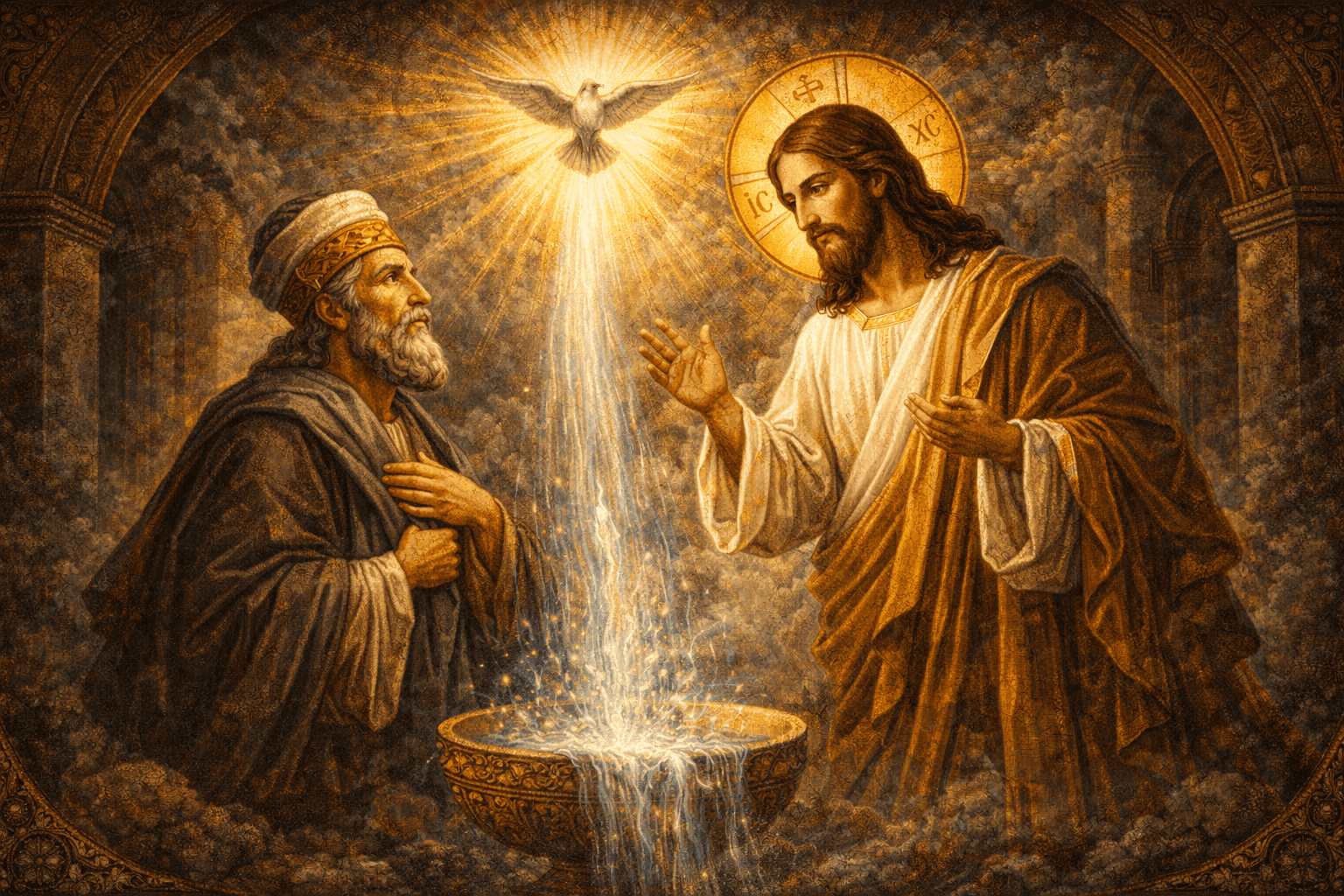
Being 'born again' refers to the spiritual transformation Jesus describes in John 3:3-8, where He tells Nicodemus that a person must be 'born of water and the Spirit' to enter the kingdom of God. It describes the regeneration of a person's spirit by the Holy Spirit — a new spiritual life that enables a person to see and enter God's kingdom.
"Born again" is one of those phrases that's everywhere in Christian culture — and almost nowhere properly explained. It's been used as a political label, a cultural category, and an embarrassing punchline. None of that is what Jesus meant.
He said it in a private conversation with one of the most educated religious men of His day — a man called Nicodemus, a Pharisee, who came to Jesus at night with questions. And Jesus said something that completely stopped him:
"Most assuredly, I say to you, unless one is born again, he cannot see the kingdom of God." (John 3:3, NKJV)
Nicodemus asked the same question you probably are: how?
What Jesus Actually Said
The conversation in John 3 is one of the most significant in the New Testament. Nicodemus — a ruler of the Jews, a scholar of Scripture — couldn't make sense of what Jesus was describing. He took it literally: how can someone re-enter their mother's womb?
Jesus clarifies in John 3:5-6 (NKJV): "Most assuredly, I say to you, unless one is born of water and the Spirit, he cannot enter the kingdom of God. That which is born of the flesh is flesh, and that which is born of the Spirit is spirit."
Physical birth brings you into physical life. Spiritual birth — being born again — brings you into spiritual life. It's not a metaphor for moral improvement or trying harder. It's a description of a new kind of existence.
What Does It Actually Involve?
Titus 3:5 (NKJV) describes it as "the washing of regeneration and renewing of the Holy Spirit." The Greek word for "born again" is anothen, which can mean both "again" and "from above" — both meanings are probably intentional. It's a birth from above, a work that originates with God, not with human effort.
Ezekiel 36:26-27 (NKJV) gives the Old Testament background: "I will give you a new heart and put a new spirit within you; I will take the heart of stone out of your flesh and give you a heart of flesh. I will put My Spirit within you and cause you to walk in My statutes." This was God's promise of what He would do — and Jesus is announcing that it's now available.
What Changes When You're Born Again
2 Corinthians 5:17 (NKJV) is as direct as it gets: "Therefore, if anyone is in Christ, he is a new creation; old things have passed away; behold, all things have become new."
New creation. Not a renovated version of the old you. A genuinely new kind of person.
What does this look like practically?
New desires. Things you wanted before start to lose their pull. Things you never cared about — Scripture, prayer, serving others — start to matter. This isn't instant or complete, but it's real.
The Holy Spirit inside you. Romans 8:9-11 says that if the Spirit of God is in you, you are a Christian. The Spirit doesn't just visit — He takes up residence. This is what makes ongoing change possible.
A new relationship with God. Not as a distant judge, but as Father (Romans 8:15). The relational dynamic changes fundamentally.
A new direction for life. Not perfection — the New Testament is clear that Christians still struggle with sin. But there's a new orientation, a new pull, a new "true north" that wasn't there before.
Can You Choose It — or Does It Just Happen?
This is where Christian traditions have differed, and it's worth being honest about that. Reformed theology emphasises that regeneration is entirely God's work — He regenerates, and then faith follows. Arminian theology emphasises human response — you respond in faith and are born again. Both positions are held by serious, Bible-believing Christians.
What both traditions agree on: being born again is not something you manufacture through effort. It involves real human response — repentance and faith — but the source of new life is the Holy Spirit, not willpower.
John 1:12-13 (NKJV): "But as many as received Him, to them He gave the right to become children of God, to those who believe in His name: who were born, not of blood, nor of the will of the flesh, nor of the will of man, but of God."
You receive. God births. Both are real.
So Have You Been Born Again?
It's worth asking directly. Not to produce anxiety, but because Jesus said it matters. The question isn't whether you were raised in a Christian home, confirmed, baptised, or attend church. The question is whether something happened — whether the Spirit of God has brought new life in you.
If you're not sure, that's a legitimate place to start. Tell God that. Tell Him you want what Jesus described. Ask for the new birth He promised.
If you want to understand what this next step looks like practically, visit our Get To Know Jesus page. And if you want someone to pray with you specifically, send a prayer request.
Key Bible Verses
John 3:1-8, John 3:16, Titus 3:5, 2 Corinthians 5:17, Ezekiel 36:26-27, 1 Peter 1:23, Romans 8:9-11, Ephesians 2:1-5, James 1:18, 1 John 5:1

Author
Shafraz Jeal
Shafraz Jeal is a Christian writer, evangelist, and ministry leader with a passion for seeing lives transformed by the gospel. Formerly a Muslim, Shafraz encountered Jesus Christ in 2016, a turning point that reshaped every part of his life. Since then, he has served in church leadership, led evangelism initiatives, and ministered in deliverance and healing. Shafraz combines biblical depth with a heart for practical discipleship, equipping believers to live boldly for Christ and inviting seekers to discover the truth of the gospel.
FAQS
Is being born again the same as being saved?
Yes — in the New Testament, the new birth, salvation, regeneration, and being 'in Christ' all describe the same fundamental reality from different angles. Being born again is the entry point into the Christian life, the moment of spiritual new life that comes through repentance and faith in Jesus Christ.