Zacchaeus: What His Story Is Actually About
Zacchaeus was a chief tax collector in Jericho who appears in Luke 19:1-10. He was wealthy, publicly despised, and short in stature — he climbed a sycamore tree to see Jesus over the crowd. Jesus stopped beneath the tree, looked up, called Zacchaeus by name, and invited Himself to his home. The encounter resulted in Zacchaeus publicly committing to repay anyone he had defrauded and give half his possessions to the poor. Jesus responded by declaring: "Today salvation has come to this house" (Luke 19:9, NKJV).

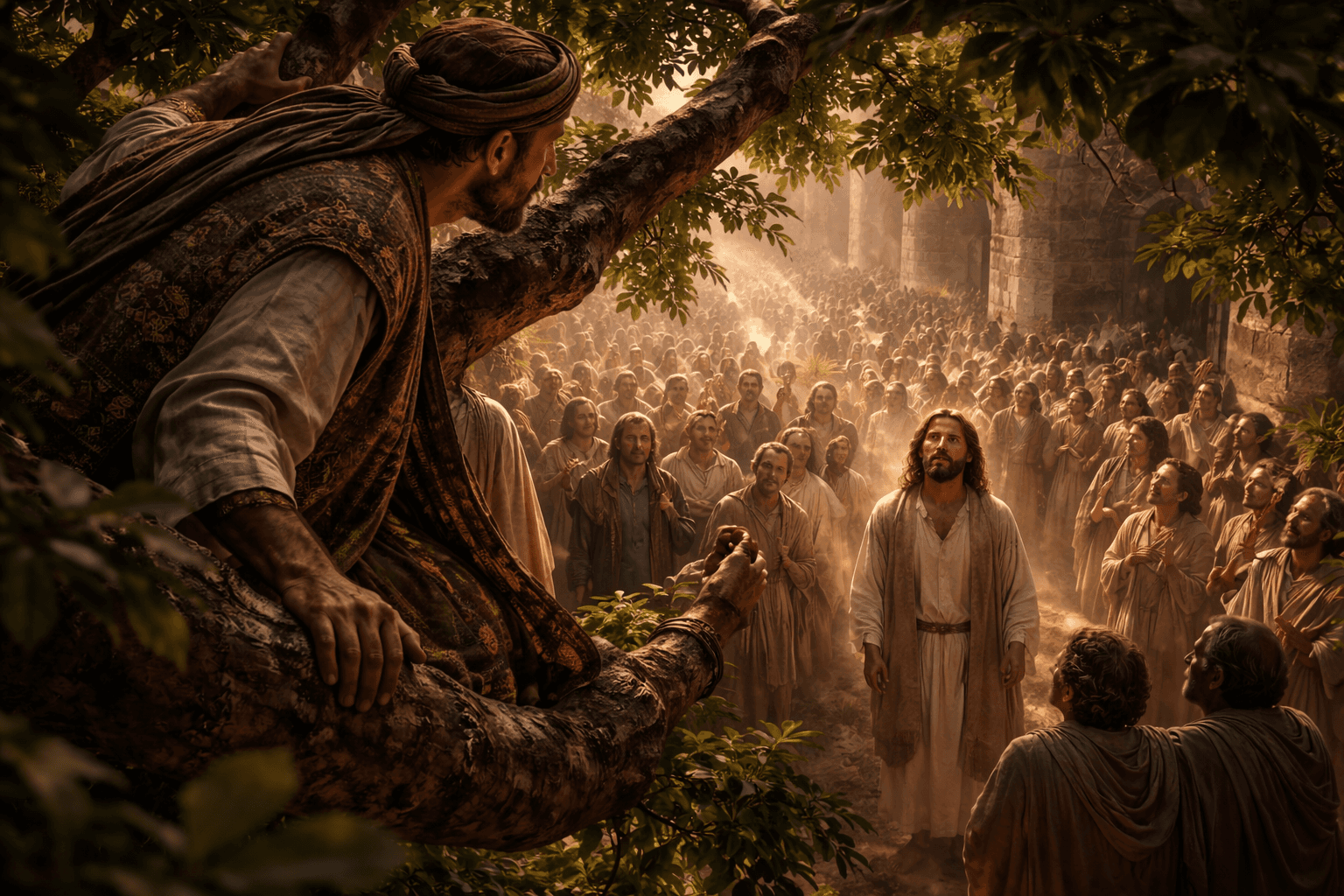
The crowd that day was significant. Jesus was passing through Jericho on His way to Jerusalem — the road that everyone knew led to the Passover, and that everyone paying attention suspected led to something more. People pressed in. They wanted to see Him.
And somewhere in that crowd was a man who had every material reason to be comfortable and every social reason to stay home. He was rich. He was the chief tax collector in a wealthy city. He was also, by the standards of his community, a traitor — a Jew who collected taxes for Rome, who almost certainly skimmed from the top, who had built his life on a transaction that his neighbours found unforgivable.
He climbed a tree. A grown man, a wealthy man, a powerful man — up into a sycamore, above the crowd, to see someone he had no reason to think would ever see him back.
What Made Zacchaeus What He Was
Tax collectors in first-century Judea operated under a system designed for corruption. The Roman government auctioned off the right to collect taxes in a given region. Whoever won the bid paid Rome upfront and then collected what they could from the population — keeping everything above the required amount. The system was built to produce exactly what Zacchaeus apparently was: a man who had extracted wealth from his own people in exchange for the protection of an occupying empire.
He wasn't just disliked. In the social and religious framework of the day, tax collectors were treated as ritually unclean — outside the community of Israel, beyond the boundaries of decent society. Luke 15:2 records Pharisees and scribes grumbling that Jesus "receives sinners and eats with them." Tax collectors were the category they were most offended by.
So Zacchaeus was rich, despised, isolated, and — from what Luke implies — aware of exactly what he had done to become those things. He had made his choices. He lived inside the consequences of them. And he climbed a tree anyway.
The Moment Jesus Stopped
Luke records it simply:
"And when Jesus came to the place, He looked up and saw him, and said to him, 'Zacchaeus, make haste and come down, for today I must stay at your house.'" (Luke 19:5, NKJV)
He looked up. Among everyone pressing in — the disciples, the crowd, the people calling out — Jesus stopped at this particular tree and looked up at this particular man. And He used his name.
That detail matters. In a society where tax collectors were treated as non-persons — morally outside the community, not to be greeted or touched — being called by name by a rabbi in front of a crowd was not nothing. It was a public statement about the value of the person being named.
And then: I must stay at your house. Not: you seem interesting, let me consider you. Not: if you repent first, perhaps. I must. Today. There's an urgency to it — and it's Jesus initiating, not Zacchaeus. Zacchaeus climbed the tree to see. Jesus is the one who stopped, looked, called him down, and invited Himself over for dinner.
What Happened at the House
Luke doesn't record the conversation that happened at Zacchaeus's house. We don't know what Jesus said to him over the meal, or how long they were there, or what Zacchaeus asked. What we get is the outcome — and the outcome is remarkable:
"Then Zacchaeus stood and said to the Lord, 'Look, Lord, I give half of my goods to the poor; and if I have taken anything from anyone by false accusation, I restore fourfold.'" (Luke 19:8, NKJV)
Half his possessions to the poor. And fourfold restitution for anyone he had defrauded — the same standard prescribed in the Law for theft (Exodus 22:1). He was not rounding down. He was applying the most demanding standard available and applying it voluntarily, in public, without being asked to.
The crowd had grumbled when Jesus went to his house: "He has gone to be a guest with a man who is a sinner." (Luke 19:7, NKJV). They wanted Zacchaeus excluded. Jesus had gone for dinner. And now the man they wanted excluded was publicly restructuring his entire financial life.
Jesus responds:
"Today salvation has come to this house, because he also is a son of Abraham; for the Son of Man has come to seek and to save that which was lost." (Luke 19:9-10, NKJV)
A son of Abraham. Not an outsider. Not beyond the covenant. Restored to the people he had been separated from — not by the crowd's permission but by Jesus's declaration. And then the verse that functions as the thesis statement of the whole encounter: the Son of Man came to seek and save the lost. Zacchaeus didn't find Jesus by climbing a tree. Jesus found Zacchaeus before Zacchaeus knew he was being looked for.
The Shape of What Changed Him
There is no record of Zacchaeus being lectured about his sin before the meal. No record of Jesus listing his offences or requiring a confession before agreeing to come in. Jesus came to his house first. The repentance came out of the encounter — not as a condition for it.
This is the pattern that runs through Jesus's dealings with people on the edges: acceptance precedes transformation. Not acceptance instead of transformation — Zacchaeus's response is total and costly. But the sequence matters. The welcome came first. The changed life followed from it.
The Person Nobody Expected
The crowd had decided Zacchaeus was a lost cause before Jesus arrived in Jericho. They knew what he was. They knew what he had done. They had categorised him, and the category was: beyond redemption, not worth engaging, not one of us.
Jesus stopped at his tree. Called his name. Went to his house. And by the end of a single meal, the man the crowd had written off was giving away half his wealth and making restitution at four times the rate the law required.
The Son of Man came to seek and save the lost. Not the people the crowd decided were worth finding. The ones nobody else was looking for.
FAQS
Who was Zacchaeus in the Bible?
Why did Zacchaeus climb a tree?
What did Jesus say to Zacchaeus?
What is the meaning of the story of Zacchaeus?
Why did the crowd grumble about Jesus visiting Zacchaeus?
Author
Shafraz Jeal
Shafraz Jeal is the founder of By Design Ministry, created to help people discover Jesus, understand the Bible, and grow in faith. After encountering Christ in 2016, his life was radically changed, and that journey continues to shape everything he shares.
You may also like these
Related Post