What Does Iniquity Mean in the Bible?
Iniquity in the Bible refers to moral perversity, a twisting away from what is right, or deliberate wrongdoing — distinct from general sin (missing the mark) or transgression (crossing a boundary). The primary Hebrew word is avon, carrying the sense of crookedness, perversion, or guilt. The Greek adikia means unrighteousness or wrongdoing. Iniquity often appears in Scripture in contexts of willful, accumulated, or particularly severe wrongdoing — as well as in its complete removal by God's forgiveness, most notably in Isaiah 53:6 and Psalm 103:12.
Author | Shafraz Jeal
6
min read
Iniquity in the Bible refers to moral perversity, a twisting away from what is right, or deliberate wrongdoing — distinct from general sin (missing the mark) or transgression (crossing a boundary). The primary Hebrew word is avon, carrying the sense of crookedness, perversion, or guilt. The Greek adikia means unrighteousness or wrongdoing. Iniquity often appears in Scripture in contexts of willful, accumulated, or particularly severe wrongdoing — as well as in its complete removal by God's forgiveness, most notably in Isaiah 53:6 and Psalm 103:12.
English Bibles use several words for wrongdoing that, in the original Hebrew and Greek, carry genuinely different meanings: sin, transgression, trespass, iniquity. In modern English, these get used more or less interchangeably — we don't tend to think of them as distinct. But the biblical writers chose them with some care, and iniquity in particular carries a specific weight that the other words don't.
Understanding it doesn't require a seminary degree. It requires noticing what the word is doing in the passages where it appears — and the picture it gives of both the depth of human wrongdoing and the completeness of God's forgiveness of it.
What Iniquity Means
The Hebrew word most commonly translated "iniquity" is avon — from a root meaning to bend, to twist, to be crooked. Iniquity is not merely doing the wrong thing. It carries the sense of a fundamental perversion — a twisting away from what is right that goes beyond individual acts into a settled orientation away from God.
Contrast this with the other primary Hebrew words for sin: chata (to miss the mark, to fall short) and pesha (transgression — deliberately crossing a boundary, rebellion). Sin misses the standard. Transgression defies the boundary. Iniquity describes the moral crookedness underneath both — the bent nature from which sinful acts flow.
Psalm 51 — David's prayer of repentance after his sin with Bathsheba — uses all three words: "Have mercy upon me, O God... blot out my transgressions [pesha]. Wash me thoroughly from my iniquity [avon], and cleanse me from my sin [chata]." (vv.1-2, NKJV). David is not being repetitive for style. He is describing the full scope of what needs to be addressed: the deliberate violation, the deeper crookedness, and the general falling short — all of it in need of God's mercy.
Iniquity in Key Passages
Isaiah 53:6 (NKJV) uses iniquity in one of the most significant statements in the Old Testament about the coming Messiah:
"All we like sheep have gone astray; we have turned, every one, to his own way; and the Lord has laid on Him the iniquity of us all."
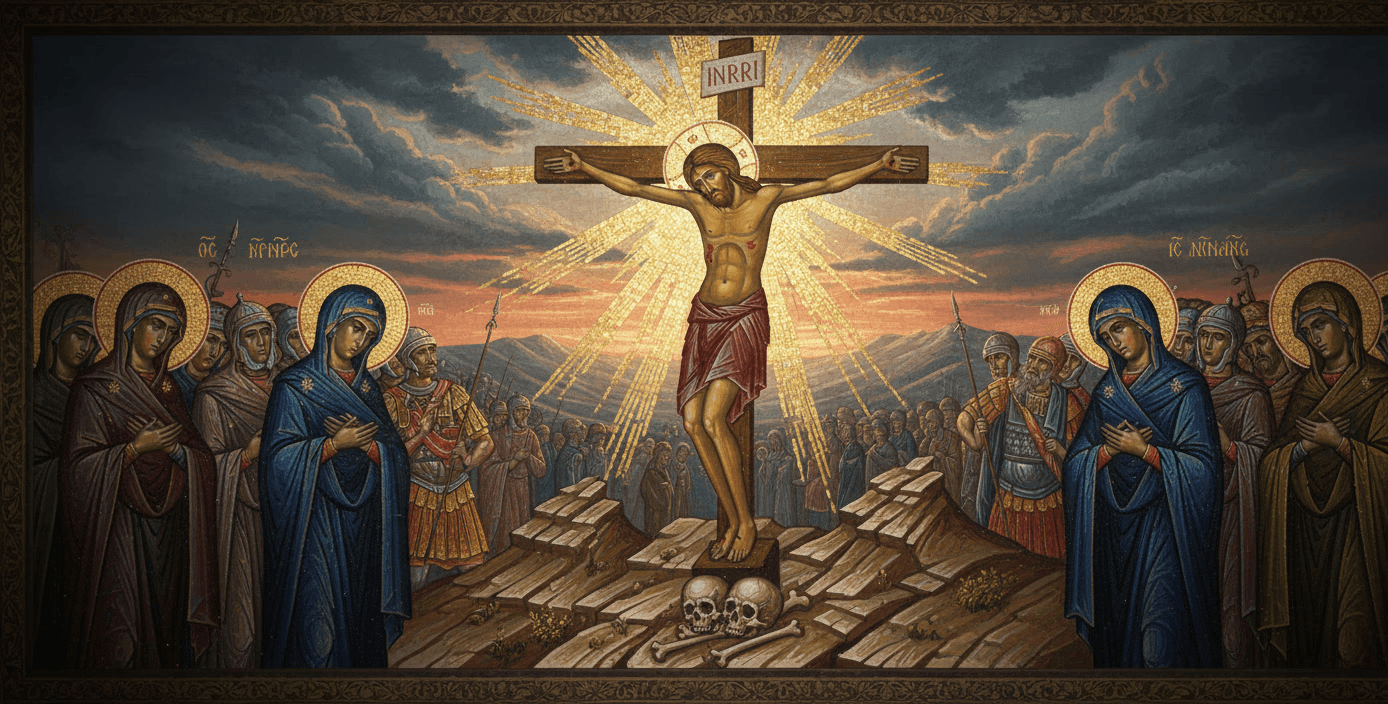
Laid on Him the iniquity of us all. Not the record of individual acts but the accumulated weight of human moral crookedness — the avon, the twisted nature and its guilt — placed on the Servant of God who bears it in place of those who produced it. The New Testament identifies this Servant as Jesus. 1 Peter 2:24 (NKJV): "He Himself bore our sins in His own body on the tree."
Exodus 34:7 (NKJV) gives one of the Old Testament's most comprehensive descriptions of God's character: He is "forgiving iniquity and transgression and sin." The three words again — and all three are within God's capacity to forgive. Iniquity is not too crooked for Him. The twisted nature is not beyond His reach.
Psalm 103:12 (NKJV): "As far as the east is from the west, so far has He removed our transgressions from us." The word "transgressions" here is pesha — but the verse sits in a context that covers iniquity throughout: "who forgives all your iniquities" (v.3). The image of east from west — infinite, unmeasurable distance — is the image God gives for how thoroughly He has removed the guilt of sin, including iniquity. Not managed. Not reduced. Removed to an infinite distance.
Micah 7:18-19 (NKJV): "Who is a God like You, pardoning iniquity and passing over the transgression of the remnant of His heritage?... He will again have compassion on us, and will subdue our iniquities. You will cast all our sins into the depths of the sea." Subdued. Cast into the sea. The language of iniquity's defeat and removal is total, not partial.
Iniquity and What It Separates
Isaiah 59:2 (NKJV) names what iniquity does in its unaddressed state: "But your iniquities have separated you from your God; and your sins have hidden His face from you, so that He will not hear." Separation. The broken relationship between humanity and God — which the whole of the Gospel is about restoring — has iniquity at its root. Not just individual acts but the fundamental crookedness of human moral orientation, turned away from God.
Titus 2:14 (NKJV) describes what Christ gave Himself to accomplish: "who gave Himself for us, that He might redeem us from every lawless deed and purify for Himself His own special people, zealous for good works." The redemption covers every lawless deed — including iniquity at its deepest. And the purification moves in the other direction: toward a people who are genuinely oriented toward what is good, not merely constrained from what is bad.
Why the Specific Word Matters
Iniquity is worth knowing because it refuses to reduce human wrongdoing to a collection of fixable individual mistakes. It names something deeper: a bent nature, a fundamental orientation away from God, a moral crookedness that produces sinful acts the way a crooked foundation produces crooked walls. You don't fix that by trying harder. You can't straighten it yourself.
Which is precisely why the passages that speak of God forgiving and removing iniquity carry such weight. It is not just that the record is cleared — it is that what was fundamentally twisted is addressed by God Himself. Ezekiel 18:30 (NKJV): "Repent, and turn from all your transgressions, so that iniquity will not be your ruin." The possibility of turning — and of iniquity not being your ruin — is the offer of the Gospel. And the God who makes that offer is the one Micah 7:18 describes as one who "delights in mercy." The crookedness can be addressed. The question is whether you'll bring it to the one who addresses it.
FAQs
What does iniquity mean in the Bible?
What is the difference between sin, iniquity, and transgression?
What does Isaiah 53:6 mean by "the iniquity of us all"?
Can God forgive iniquity?
What does "workers of iniquity" mean in the Bible?

Author
Shafraz Jeal
Shafraz Jeal is the founder of By Design Ministry, created to help people discover Jesus, understand the Bible, and grow in faith. After encountering Christ in 2016, his life was radically changed, and that journey continues to shape everything he shares.
You may also like these
Related Post